Programming Is Coming Full Circle: Abstractions to Intent
Will future developers look at the way we code today in the same way we look at the ENIAC operators or the Apollo engineers writing raw assembly? We are increasingly using AI to write the code, write the tests, review the code, and then simplify it based on the implementation keeping in mind the original intent. In the era of Intent, Taste is the new Syntax.
We are living through the era where human-readable code becomes a historical relic. If the AI is writing and AI is reviewing, and AI is simplifying. Do we even need the syntax anymore? pic.twitter.com/E2wFD2b2NV
— Varun Singh (@vr000m) February 28, 2026
I started my journey writing GW BASIC, dBase, then C++, downgraded to C, upgraded to Python, then JavaScript, with some forgettable forays into Java, Objective-C, Go. Each level of abstraction was a productivity boost — standing on the shoulders of giants — but one step further from the bare metal. Over the past year, I have begun to trust the AI-generated code. This did not happen suddenly. It has come with a lot of trials and tribulations, abandoned projects, frustration with the models. However, the harnesses (claude, codex, jules) have been improving rapidly, and the generated code via the harnesses is run through a series of thinking, code execution, and testing steps that is reducing the gap between the original intent and actual implementation. The quality of code is significantly better. With each iteration, my confidence in the generated code is increasing.
We are rapidly moving from writing in programming languages to natural language, i.e., using plain English to describe our intent more precisely, and moving our focus from writing the code to verifying the correctness of the generated code. If we then move to verifying the operation of the code, we can perhaps then just stop focusing on reviewing the code altogether. This raises the question: why do we need programming languages at all? The LLM could easily produce the machine code directly from our intent.
The biggest pushback I can foresee to getting rid of the intermediate language representation is debugging or verification (especially security related). How do you fix what you cannot read?
We are perhaps moving from tracing (manually following a code path) to triangulation (AI-driven root cause analysis). In this new era, debugging is not about finding a typo; it is about refining the feedback loop. If a system fails, the AI does not just show us a stack trace; it analyses the telemetry, compares the binary execution against our original intent, and self-corrects (à la OpenClaw). If we need to understand 'why,' the AI can generate a high-level human-readable map of the logic on the fly (e.g., using natural language or programming language of your choice). We do not need the code to be readable; we just need the AI to be able to explain it when asked.
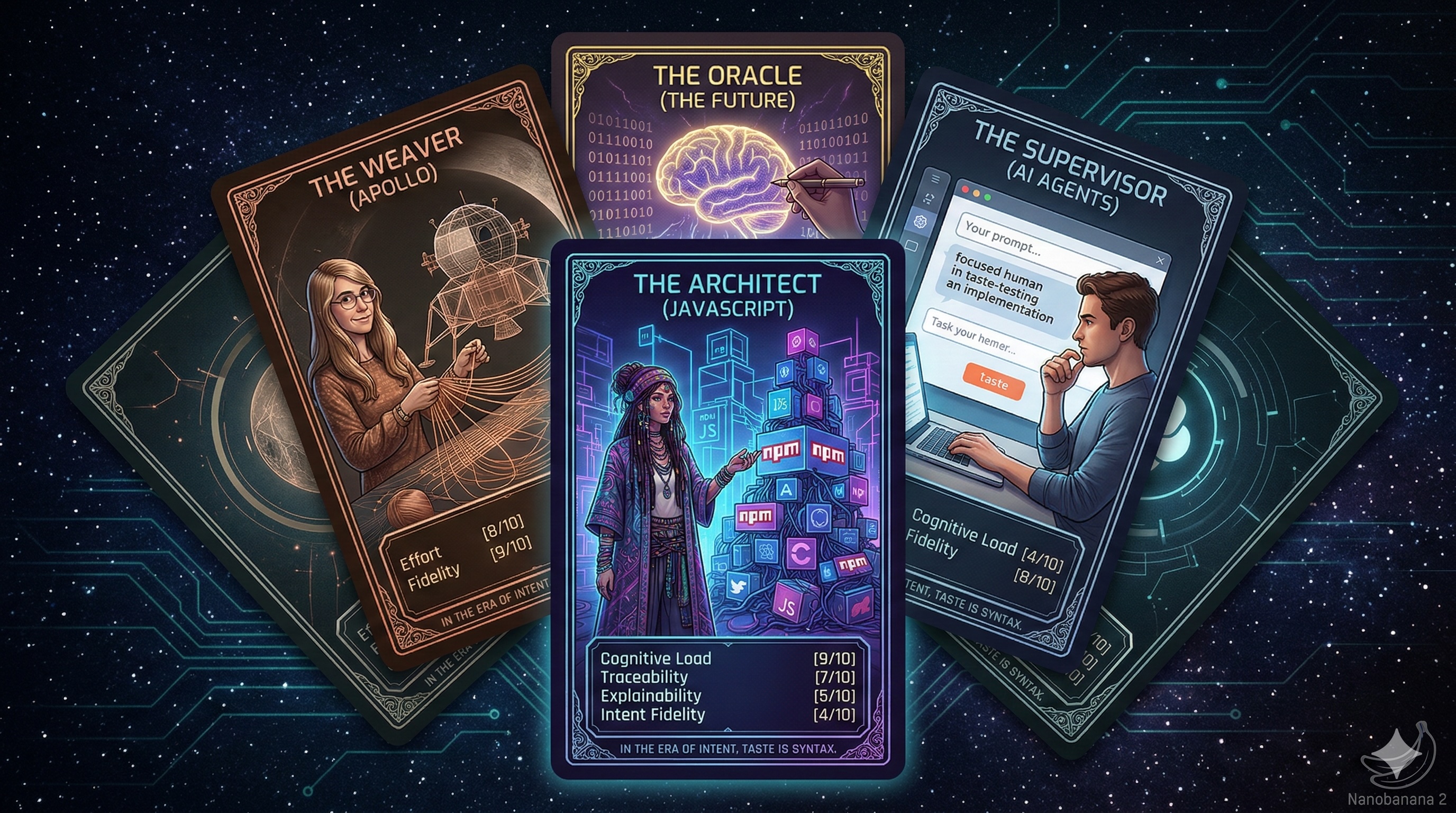
The evolution of programming:
| Era | The Interface | The Code | The Human Role |
|---|---|---|---|
| 1. ENIAC | Physical Cables | Hardware is the code | Physically patching circuits to define logic. |
| 1-bis. Apollo | Punch Cards / Terminals | Assembly baked into rope memory | Writing the functionality into physical components. |
| 2. JS/C++ | Programming Languages | Human-readable logic | Managing abstractions; standing on the "shoulders of giants." |
| 3. AI Agents | Natural Language / Prompts | AI-generated "Black Box" | Defining objectives (taste); Observing and testing the implementation. |
| 4. The Future | Thought / Speech | Direct Machine Binary | Defining outcomes; the machine handles the "how" entirely. |
We started by wiring machines directly, then writing in assembly, then writing in high-level languages which mimic human thought processes (close but not quite human language). We are now chatting with an agent to write the code for us, expressing what we want, how it will be used, and what it should do. Eventually, we may not need to see the code — the layers of abstraction collapsing back into pure intent meeting bare metal. The circle closes.
UPDATED (2026-02):: Nano Banana 2 🍌 🍌 images added. Added tweet.